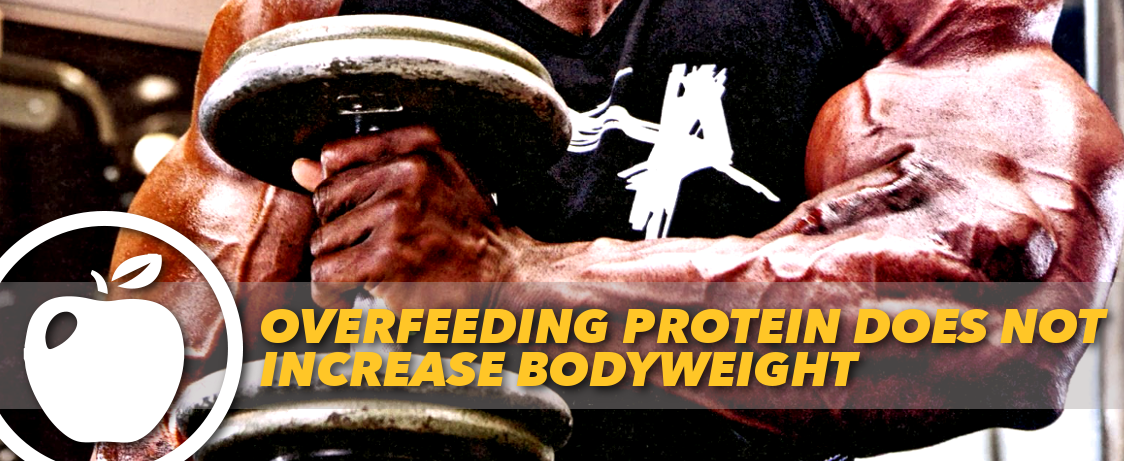
For years, nutritionists have said, “ A Calorie is a Calorie!” We now know that this is the furthest from the truth. Researchers wanted to examine the impact of a high protein diet to examine if it had any impact on weight gain, according to the all calories are created equal theory, the participants should gain weight after overfeeding protein. Thirty healthy resistance-trained individuals were randomly assigned to one of the following groups: control or high protein.
The control group was instructed to maintain the same training and dietary habits over the course of the 8-week study. The high protein group was instructed to consume 4.4 grams of protein per kg body weight daily. They were also instructed to maintain the same training and dietary habits (e.g. maintain the same fat and carbohydrate intake). Body composition, training volume, and food intake were determined at baseline and over the 8-week treatment period.
At the end of eight weeks, the high protein group consumed significantly more protein and calories pre vs. post. Furthermore, the high protein group consumed significantly more protein and calories than the control. The high protein group consumed on average 307 ± 69 grams of protein compared to 138 ± 42 in the control. When expressed per unit body weight, the high protein group consumed 4.4 ± 0.8 g/kg/d of protein versus 1.8 ± 0.4 g/kg/d in the control. There were no changes in training volume for either group. Moreover, there were no significant changes over time or between groups for body weight, fat mass, fat free mass, or percent body fat.
Consuming 5.5 times the recommended daily allowance of protein has no effect on body composition in resistance-trained individuals who otherwise maintain the same training regimen. This is the first interventional study to demonstrate that consuming a hypercaloric high protein diet does not result in an increase in body fat. This is in contrast with other overfeeding studies, which showed gains in body weight, fat mass and lean body mass; however, those investigations were performed in non exercise-trained individuals that were consuming a lower protein diet.
The really interesting aspect of the study was that the high protein-eating group consumed over 800 calories more per day for eight weeks and still did not gain weight. The high protein group consumed an extra 145 grams of protein daily (mean intake of 307 grams per day or 4.4 g/kg/d). The researchers suggested several reasons why the high protein group may have not gained weight because of the thermic effect of protein. The high thermic effect of protein may make it difficult to gain body weight during times of overfeeding. It has been shown that the greater the protein contents of a meal, the higher the thermic effect.
Both young and old individuals experience an increase in resting energy expenditure after a 60-gram protein meal (17-21% increase). So if you’re dieting and need to eat something, a high protein snack is a better option to keep the weight off. Another interesting finding was that the higher protein group did not gain any more lean muscle mass than the control group, so don’t be expecting to pack on greater increases in lean muscle mass by eating more protein but it will keep your bodyweight in check.
.
References:
Lemon PW: Do athletes need more dietary protein and amino acids? Int J Sport Nutr 1995, 5(Suppl):S39-S61.
Lemon PW, Tarnopolsky MA, MacDougall JD, Atkinson SA: Protein requirements and muscle mass/strength changes during intensive training in novice bodybuilders. J Appl Physiol 1992, 73:767-775.
Lemon PW, Proctor DN: Protein intake and athletic performance. Sports Med 1991, 12:313-325.
Lemon PW: Protein and amino acid needs of the strength athlete. Int J Sport Nutr 1991, 1:127-145.
Lemon PW: Protein and exercise: update 1987. Med Sci Sports Exerc 1987, 19:S179-S190.
Belko AZ, Barbieri TF, Wong EC: Effect of energy and protein intake and exercise intensity on the thermic effect of food. Am J Clin Nutr 1986, 43:863-869.
Fukagawa NK, Bandini LG, Lim PH, Roingeard F, Lee MA, Young JB: Protein-induced changes in energy expenditure in young and old individuals. Am J Physiol 1991, 260:E345-E352
Swaminathan R, King RF, Holmfield J, Siwek RA, Baker M, Wales JK: Thermic effect of feeding carbohydrate, fat, protein and mixed meal in lean and obese subjects. Am J Clin Nutr 1985, 42:177-181.
Acheson KJ, Blondel-Lubrano A, Oguey-Araymon S, Beaumont M, Emady-Azar S, Ammon-Zufferey C, Monnard I, Pinaud S, Nielsen-Moennoz C, Bovetto L: Protein choices targeting thermogenesis and metabolism. Am J Clin Nutr 2011, 93:525-534.
Volek JS, Volk BM, Gomez AL, Kunces LJ, Kupchak BR, Freidenreich DJ, Aristizabal JC, Saenz C, Dunn-Lewis C, Ballard KD, Quann EE, Kawiecki DL, Flanagan SD, Comstock BA, Fragala MS, Earp JE, Fernandez ML, Bruno RS, Ptolemy AS, Kellogg MD, Maresh CM, Kramer WJ: Whey protein supplementation during resistance training augments lean body mass. J Am Coll Nutr 2013, 32:122-135
Robbie Durand has been in the sports supplement and bodybuilding industry for 15 years. He has contributed to many national magazines and web sites. He has an M.A. in exercise physiology from Southeastern University and a B.A. in Dietetics from Louisiana State University.