Benefits of N-Acetylcysteine and Glutathione Support
N-acetylcysteine, better known as NAC, has become one of the more interesting amino acid-derived supplements in the world of health, longevity, and sports nutrition.
NAC is best known for its relationship with glutathione, one of the body’s most important antioxidant systems. Researchers have studied NAC for decades, particularly because it provides cysteine, an amino acid required to produce glutathione.
More recent research has generated additional interest by examining what happens when NAC is paired with glycine, another amino acid needed to make glutathione. Studies in older adults have reported improvements in glutathione status and several markers associated with oxidative stress, metabolism, inflammation, and physical function.
That doesn’t mean NAC is a miracle supplement or an anti-aging cure. The human research is still relatively limited, and some of the most dramatic findings have come from specific populations, particularly older adults with low glutathione levels.
Still, the science behind NAC is compelling enough to make it worth understanding. Our team at Generation Iron is going to break it down.
What Is NAC?
NAC stands for N-acetyl-L-cysteine. It is a derivative of the amino acid cysteine and is widely used as a source of cysteine for the body’s glutathione production.
Glutathione is made from three amino acids:
- Glutamate
- Cysteine
- Glycine
Cysteine is particularly important because its availability can limit how much glutathione the body can produce.
This is one reason NAC has received so much attention. Rather than simply acting as another antioxidant, NAC can provide the body with a building block needed to manufacture its own glutathione.
Why Is Glutathione So Important?
Glutathione plays a central role in the body’s antioxidant and cellular defense systems.
It helps neutralize reactive molecules, participates in detoxification pathways, helps maintain cellular redox balance, and contributes to the recycling of other antioxidants.
Glutathione is also important to mitochondrial function. Mitochondria are the structures responsible for producing much of the energy used by cells, making their ability to function properly particularly important for metabolism, exercise, and overall cellular health.
The problem is that glutathione levels can decline with age and under conditions associated with increased oxidative stress.
That has led researchers to ask an interesting question: Can providing the building blocks for glutathione production help restore the body’s antioxidant system?
NAC, Glycine, and the “Power of 3”
Some of the most interesting research in this area has focused on combining NAC and glycine rather than using NAC alone.
The concept is straightforward. NAC supplies cysteine. Glycine supplies glycine. Together, they provide two of the three amino acids required to manufacture glutathione.
Researchers have described this concept as the “Power of 3” — glycine, cysteine, and the glutathione they produce together.
This distinction is important because taking NAC alone doesn’t necessarily address every factor that can limit glutathione production.
Likewise, taking glycine alone doesn’t provide additional cysteine.
Providing both building blocks may therefore offer a more comprehensive approach to supporting glutathione synthesis, particularly in people whose glutathione levels are already low.
NAC and Oxidative Stress

One of the primary reasons people take NAC is to support the body’s defenses against oxidative stress. Oxidative stress occurs when reactive molecules are produced faster than the body’s antioxidant systems can neutralize them.
Research involving NAC and glycine supplementation in older adults has reported reductions in markers associated with oxidative stress and lipid peroxidation, while also improving glutathione status.
These findings are particularly interesting because oxidative stress is involved in numerous normal biological processes and tends to increase with age.
However, it’s important not to interpret these findings as proof that NAC prevents aging or eliminates oxidative stress. Oxidative molecules also play useful roles in normal cellular signaling, and the goal isn’t to eliminate them entirely.
The goal is maintaining a healthy balance.
NAC and Mitochondrial Function
Another area of interest is mitochondrial health. Mitochondria need effective antioxidant defenses to function properly. Excessive oxidative stress can interfere with cellular processes and mitochondrial performance.
Research examining glutathione restoration through glycine and NAC has reported improvements in measures related to mitochondrial function, including greater fat oxidation and cellular energy production.
For active adults, this is particularly interesting because efficient mitochondrial function plays a role in endurance, energy metabolism, and exercise capacity.
Again, these findings shouldn’t be interpreted as proof that NAC is a performance-enhancing supplement. The research is still developing, and results can vary significantly depending on the individual and the circumstances.
NAC, Insulin Resistance, and Metabolic Health
Glutathione and oxidative stress are also connected to metabolic health. Some research involving older adults has reported improvements in insulin resistance following glycine and NAC supplementation.
This is potentially important because insulin sensitivity tends to decline with age, while metabolic dysfunction can contribute to a variety of health problems.
However, NAC should not be viewed as a replacement for the fundamentals of metabolic health.
Resistance training, regular cardiovascular activity, maintaining a healthy body composition, eating a nutrient-dense diet, getting sufficient sleep, and managing calorie intake remain far more important.
NAC may be an interesting addition to those habits, but it isn’t a substitute for them.
NAC and Inflammation

Researchers have also examined the relationship between glutathione status, oxidative stress, and inflammation.
Studies of glutathione precursor supplementation have reported reductions in inflammatory markers including IL-6, TNF-alpha, and high-sensitivity C-reactive protein (hs-CRP) in certain populations.
These markers are commonly used in research to evaluate inflammatory activity. The important caveat is that lowering an inflammatory marker doesn’t automatically mean a supplement prevents disease. Biomarkers are useful pieces of information, but they don’t tell the entire story.
Still, the simultaneous changes in oxidative stress, glutathione status, metabolism, and inflammatory markers are part of what makes this research so interesting.
NAC and Physical Performance
Some studies have also reported improvements in physical function following interventions designed to restore glutathione.
Reported outcomes have included improvements in:
- Exercise capacity
- Strength
- Gait speed
- Muscle-related measures
- Body composition
Gait speed is particularly interesting in aging research because walking speed is associated with overall physical function and health outcomes in older adults.
However, these results should be interpreted in context. The studies were relatively small, and the strongest findings have generally been observed in older adults with evidence of impaired glutathione status.
That doesn’t mean a healthy 25-year-old taking NAC will suddenly become stronger, leaner, or more athletic.
What About Cognitive Function?
The research has also explored cognitive outcomes. Some studies examining glutathione restoration in older adults have reported improvements in measures of cognitive performance, processing speed, and executive function.
These findings are promising, but they’re still preliminary. Small clinical trials are useful for identifying potential effects that deserve further investigation, but they aren’t enough to establish that NAC or glycine prevents cognitive decline.
More large-scale, long-term research is needed.
Can NAC Make You “Younger”?
This is where some of the claims surrounding NAC and glutathione can become exaggerated.
Research has reported that certain biomarkers in older adults receiving glycine and NAC supplementation moved toward levels seen in younger adults. In some cases, the differences between older and younger participants became statistically insignificant after approximately 16 to 24 weeks.
That’s fascinating—but it doesn’t mean the participants literally became biologically young again.
The studies measured specific physiological and biochemical markers. They did not prove that NAC reverses aging, extends human lifespan, or makes someone immune to age-related disease.
The distinction matters.
How Much NAC Was Used in the Research?
The doses used in some of the glycine-and-NAC studies were considerably higher than the amount found in many commercial NAC supplements.
Research protocols have used approximately 100 mg/kg per day of glycine and 100 mg/kg per day of NAC, divided throughout the day.
For a 70 kg adult, that’s approximately:
- 7 grams of glycine per day
- 7 grams of NAC per day
These are research doses and should not automatically be interpreted as a recommended daily supplement regimen.
In fact, these amounts are significantly higher than the 600 mg NAC commonly found in retail NAC products.
This is an important distinction when discussing the research because consumers shouldn’t assume that taking one 600 mg capsule will reproduce the results of a study using several grams of NAC.
Why Nutricost NAC Is Worth Considering
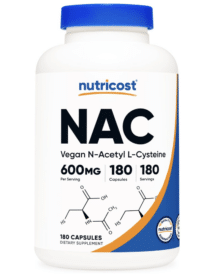
For people who want to add NAC to their supplement routine, Nutricost NAC offers a straightforward way to get a standardized dose.
Each capsule contains 600 mg of N-acetyl-L-cysteine, a dosage commonly found in NAC supplements and frequently used in research settings.
Nutricost also offers 180 veggie capsules per bottle and lists the product as vegan, non-GMO, and gluten-free.
The company states that the product is manufactured in an NSF-certified, GMP-compliant, FDA-registered facility and undergoes third-party testing by independent, ISO-accredited laboratories.
Nutricost NAC Key Features
- 600 mg of N-acetyl-L-cysteine per capsule
- 180 veggie capsules
- Vegan
- Non-GMO
- Gluten-free
- Manufactured in an NSF-certified, GMP-compliant, FDA-registered facility
- Third-party tested by independent, ISO-accredited laboratories
- Listed price: $39.95
The combination of a clearly labeled 600 mg dose, a simple formula, and third-party testing makes Nutricost NAC a practical option for people interested in adding NAC to their supplement regimen.
Is NAC Safe?
NAC is generally well tolerated, but that doesn’t mean it’s appropriate for everyone.
Some people may experience gastrointestinal side effects such as nausea, diarrhea, abdominal discomfort, or an unpleasant taste.
NAC can also interact with certain medications. People taking nitrates or blood-thinning medications, as well as individuals with kidney disease or other medical conditions, should talk with their physician before supplementing.
Anyone taking prescription medication should also discuss NAC with their healthcare provider before adding it to their routine.
And if you’re considering NAC or glycine because of abnormal bloodwork, fatigue, insulin resistance, inflammation, or another health concern, it’s better to address the underlying issue with a medical professional rather than attempting to self-treat with supplements.
NAC Isn’t a Magic Bullet
The most important takeaway from the research may actually be what NAC doesn’t do.
The studies examining glycine and NAC have generally been relatively small. Some of the strongest effects have been observed in older adults with documented glutathione deficiency or impaired glutathione metabolism.
We also don’t have sufficient evidence to say that NAC extends human lifespan.
Some longevity findings have come from animal research, while the human studies have primarily examined biomarkers and functional outcomes over relatively short periods.
And the benefits aren’t necessarily permanent. When supplementation is discontinued, the improvements in glutathione-related measures can diminish.
In other words, this appears to be maintenance rather than a cure.
The Bottom Line
NAC is much more than another antioxidant supplement.
Its primary appeal comes from its role as a source of cysteine, which can help the body produce glutathione, a critical component of the body’s antioxidant and cellular defense system.
Research into NAC—particularly when combined with glycine—has produced intriguing findings involving glutathione levels, oxidative stress, mitochondrial function, insulin sensitivity, inflammatory markers, physical performance, and cognitive measures.
But the science shouldn’t be overstated.
The most exciting results have largely come from smaller studies and specific populations, particularly older adults with low glutathione status. More research is needed to determine how broadly these findings apply and whether they translate into meaningful long-term health or longevity benefits.
For someone looking for a convenient NAC supplement, Nutricost NAC provides 600 mg per capsule and offers third-party testing and quality-focused manufacturing at a listed price of $39.95.
Ultimately, NAC isn’t a replacement for a healthy diet, exercise, sleep, or medical care. Think of it as a tool that may help support a biological system your body already uses every day.
Sometimes, the most interesting approach to better health isn’t finding an exotic new molecule. It’s giving the body the building blocks it needs to do what it was already designed to do.
Let us know what you think in the comments below. Also, be sure to follow Generation Iron on Facebook, Twitter, and Instagram.
References
- Kumar P, Liu C, Hsu JW, et al. Glycine and N-acetylcysteine (GlyNAC) supplementation in older adults improves glutathione deficiency, oxidative stress, mitochondrial dysfunction, inflammation, insulin resistance, endothelial dysfunction, genotoxicity, muscle strength, and cognition: Results of a pilot clinical trial. Clinical and Translational Medicine. 2021;11(3):e372.
- Kumar P, Liu C, Hsu JW, et al. Supplementing Glycine and N-Acetylcysteine (GlyNAC) in Older Adults Improves Glutathione Deficiency, Oxidative Stress, Mitochondrial Dysfunction, Inflammation, Physical Function, and Aging Hallmarks: A Randomized Clinical Trial. Journal of Gerontology: Series A. 2022.
- Sekhar RV. GlyNAC Supplementation Improves Glutathione Deficiency, Oxidative Stress, Mitochondrial Dysfunction, Inflammation, Aging Hallmarks, Metabolic Defects, Muscle Strength, Cognitive Decline, and Body Composition: Implications for Healthy Aging. Journal of Nutrition. 2021;151(12):3606–3616.