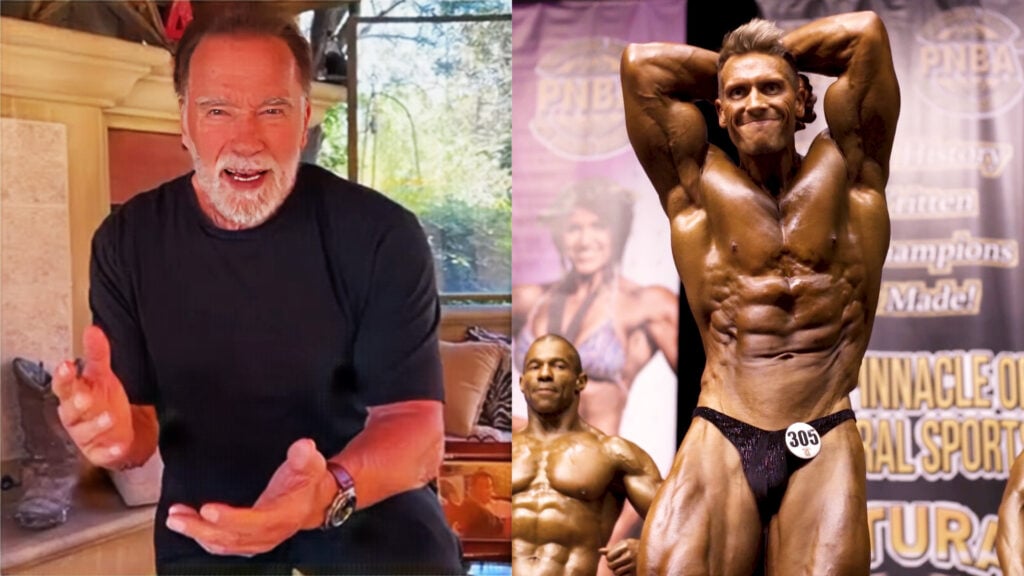
Arnold Schwarzenegger shares insights from studies that investigate how high protein intake may affect your organs
In the world of bodybuilding, few topics spark more debate than protein intake. For years, lifters have been told to push their protein higher to maximize muscle growth, recovery, and performance. But alongside that advice, a quieter fear has circulated: can eating too much protein actually harm your body, specifically by enlarging your organs?
Now, Arnold Schwarzenegger is stepping in to shut that idea down.
In his May 1, 2026 edition of the Pump Club Newsletter, Schwarzenegger addressed the growing concern head-on. Drawing from recent research, he made it clear: for natural, drug-free bodybuilders, high protein intake does not appear to cause organ enlargement.

Where the Protein Fear Started
The concern didn’t come out of nowhere. A 2019 paper suggested that when the body consumes more protein than it can use for muscle repair and growth, the excess might be redirected elsewhere. One theory proposed that this surplus could contribute to organ growth over time.
That idea spread quickly. It showed up in online forums, fitness circles, and even casual gym conversations. For many lifters, it became a reason to second-guess high-protein diets.
Schwarzenegger, who built his legendary physique during his run to seven Mr. Olympia titles, has always emphasized protein as a cornerstone of bodybuilding nutrition. Even now, in his seventies, he continues to prioritize clean eating, though his diet has shifted toward more plant-based sources.
That shift made him take a closer look at protein science, especially the claims that have caused confusion among natural athletes.
What the New Study Found
According to Arnold Schwarzenegger, the latest research goes beyond theory and actually tests the claim.
Scientists examined three groups:
- Bodybuilders using performance-enhancing drugs (PEDs)
- Natural bodybuilders
- Recreationally active individuals (control group)
All groups were analyzed for organ size using imaging technology. Researchers focused on major organs like the heart, liver, kidneys, and intestines.
The key detail is protein intake. Both groups of bodybuilders, enhanced and natural, were consuming similarly high levels of protein, often exceeding 2.5 grams per kilogram of bodyweight per day. That’s more than double the standard recommendation.
Meanwhile, the control group averaged around 1.4 grams per kilogram.
If protein alone caused organ enlargement, both bodybuilding groups should have shown similar results. But that’s not what happened.
The Real Difference: Drugs, Not Diet
The findings were clear. Organ enlargement appeared only in the group using performance-enhancing drugs.
“The scientists used imaging to measure the sizes of the heart, liver, intestines, and kidneys,” Schwarzenegger explained. “Both bodybuilder groups consumed similar amounts of protein, well above 2.5 g/kg/day, while controls averaged around 1.4 g/kg/day. As you would expect, the enhanced bodybuilders had the most muscle mass, and natural bodybuilders had more than controls. But here’s the important part: organ enlargement showed up in only one group — the drug users. Natural bodybuilders’ organs looked nearly identical to those of the recreationally active controls, despite eating roughly twice as much protein.”
Natural bodybuilders, despite eating just as much protein, had organ sizes nearly identical to the recreational control group.
Arnold Schwarzenegger highlighted this distinction as the most important takeaway. The pattern is hard to ignore. Same protein intake, completely different outcomes. The only major variable separating the groups was drug use.
This strongly suggests that high protein consumption alone is not responsible for organ growth.
Instead, Schwarzenegger points to the drug protocols often used in elite bodybuilding. These typically include combinations of growth hormone, insulin, and anabolic steroids. Together, they can significantly alter how the body grows and functions.
The so-called “bubble gut” often seen on professional stages is more likely tied to these substances than to dietary protein.
Why This Matters for Natural Lifters
For drug-free athletes, this is a big deal. Protein has long been viewed as both essential and potentially risky in high amounts. Many lifters walk a fine line, trying to get enough for growth without going “too far.”
Arnold Schwarzenegger’s takeaway simplifies things. If you’re training hard and staying natural, eating higher protein levels, up to around 2.5 g/kg, does not appear to pose the risk that some feared.
That doesn’t mean more is always better. But it does mean that the typical high-protein diet used in bodybuilding is not causing hidden organ damage.
What About Fat Gain?
Another common concern is whether excess protein gets stored as fat.
Arnold Schwarzenegger addressed that as well. Based on available research, resistance-trained individuals who consumed more than double the recommended protein intake did not gain additional body fat.
This aligns with what many athletes experience in practice. Protein is less likely to be stored as fat compared to carbohydrates or fats, especially when paired with intense training.
It also has a higher thermic effect, meaning the body burns more calories digesting it.
A Note on Study Limitations
Arnold Schwarzenegger didn’t present the findings as absolute proof. He acknowledged that the study is observational, which means it shows correlations rather than direct cause-and-effect relationships. That’s an important distinction.
Still, when multiple pieces of evidence continue to point in the same direction, confidence in the conclusion grows. And in this case, the evidence keeps failing to support the idea that protein is the problem.
The Bottom Line
Arnold Schwarzenegger’s message is straightforward. If you’re a natural bodybuilder, high protein intake is not something you need to fear. The idea that it causes organ enlargement doesn’t hold up under closer scientific scrutiny.
Instead, the real risks appear to be tied to performance-enhancing drugs, not nutrition.
For everyday lifters, this should bring some relief. You can focus on hitting your protein targets without worrying that you’re quietly damaging your body.
At the same time, Schwarzenegger offered a subtle warning. While natural athletes can feel more confident in their diets, enhanced bodybuilders need to be far more cautious. The combination of drugs and extreme protocols introduces variables that go well beyond food.
Wrap Up
In a fitness world full of myths and half-truths, clarity matters.
Protein remains one of the most important tools for building muscle and supporting recovery. And thanks to insights like these, lifters can move forward with better information and fewer unnecessary fears.
Schwarzenegger has spent decades evolving with the science, and this is another example of that mindset in action. Instead of clinging to old beliefs, he’s looking at the data and adjusting the message.
For natural athletes, the takeaway is simple: eat your protein, train hard, and stop worrying about myths that don’t stand up to real-world evidence.
*Featured image via Generation Iron / Instagram @schwarzenegger