A Complete Guide to Muscle Growth Through Boxing
Boxing has long been considered one of the most intense and effective workouts for full-body fitness. With its mix of cardio, coordination, power, and agility, it’s no surprise that professional boxers are often in incredible shape. But if your goal is to build muscle, you may be wondering: Does boxing actually help with muscle growth?
The short answer is yes—boxing can build muscle. But how it builds muscle, what kind of muscle it builds, and how it compares to other forms of training like weightlifting are all key things to understand before you lace up the gloves.
Our team at Generation Iron is going to take a deep dive into the relationship between boxing and muscle development, explains the mechanics behind how muscle is built in boxing, and offers tips on how to combine boxing with other training methods for maximum results.
Understanding Muscle Growth (Hypertrophy) First

Before diving into boxing specifically, let’s cover how muscle growth actually works. The primary way muscles grow is through a process called hypertrophy—this happens when muscle fibers are damaged during exercise and then repaired stronger and thicker.
Muscle hypertrophy is generally driven by three main factors:
- Mechanical tension – Generated by lifting heavy loads or contracting muscles against resistance.
- Muscle damage – Microtears in muscle fibers caused by eccentric movements or strenuous effort.
- Metabolic stress – The “burn” you feel during high-rep or high-intensity sets, caused by the buildup of metabolites like lactic acid.
While weight training is specifically designed to target all three of these pathways, boxing touches on them—primarily through metabolic stress and muscular endurance—with some degree of mechanical tension depending on the training style.
Does Boxing Build Muscle?
Yes, boxing can and does build muscle, especially lean, functional, and explosive muscle. However, it doesn’t usually lead to large, bodybuilder-style gains. Instead, boxing focuses more on developing muscle tone, strength endurance, and athletic physique.
Boxing builds muscle primarily through:
- Repeated explosive movements, like punches and footwork, that engage fast-twitch muscle fibers.
- Resistance from hitting pads or heavy bags, which creates micro stress on the muscles.
- Bodyweight training elements, often included in boxing workouts, such as push-ups, planks, squats, and burpees.
These aspects help create well-conditioned, defined muscles, especially in the upper body and core.
What Muscles Does Boxing Work?
Boxing is a full-body workout, which means it engages almost every major muscle group in the body—some more than others. Here’s a breakdown of the main areas targeted during a boxing session:
1. Shoulders (Deltoids)
- Punching, holding your guard, and defending all rely on shoulder endurance.
- Shadowboxing and pad work build shoulder muscle tone and stamina.
2. Arms (Biceps, Triceps, Forearms)
- Every punch involves rapid extension (triceps) and retraction (biceps), building explosive strength and control.
- Holding your fists in position for long periods develops endurance and tone.
3. Chest (Pectorals)
- Vital for pushing power and punch delivery.
- Repetitive punching and push-ups in training help develop a strong, defined chest.
4. Back (Lats, Trapezius, Rhomboids)
- Crucial for rotational power and punch retraction.
- Helps stabilize your posture and generate force from the ground up.
5. Core (Abdominals, Obliques, Lower Back)
- Boxing starts in the core. Every punch is generated from the hips and rotational movement.
- Constant movement and stabilization train the abs and obliques intensively.
6. Legs (Quads, Hamstrings, Glutes, Calves)
- Footwork, pivots, and squatting stances build leg strength and endurance.
- Many boxing drills involve explosive leg movement (jump rope, squats, lunges, etc.).
Boxing vs Weight Training for Muscle Building

If your main goal is muscle hypertrophy (getting big, bulky muscles), weight training is still the most efficient method. However, that doesn’t mean boxing can’t contribute to your overall muscle development.
Here’s how boxing compares to weight training:
| Feature | Boxing | Weight Training |
|---|---|---|
| Type of Muscle Built | Lean, dense, functional | Size-focused (hypertrophy) |
| Main Resistance | Bodyweight & impact force (bags/pads) | External resistance (weights, machines) |
| Focus | Speed, power, endurance | Strength, size, symmetry |
| Reps & Intensity | High-rep, high-intensity | Moderate to high-load, low to mid-reps |
| Recovery Time | Moderate | Higher (due to greater muscle breakdown) |
If you’re boxing regularly and eating a high-protein diet, you can absolutely develop a strong, athletic physique. However, for maximum muscle mass, adding resistance training 2–3 times per week is a smart strategy.
The Best Way to Build Muscle with Boxing
If you want to use boxing to build muscle and sculpt your body, here are some tips to help maximize your results:
1. Focus on Resistance-Based Boxing
Use heavy bags, resistance bands, or weighted gloves to add tension to your punches. This increases the mechanical load and improves strength development.
2. Include Bodyweight Strength Circuits
Push-ups, pull-ups, dips, squats, and lunges are often part of a boxer’s training plan. These help develop upper body, lower body, and core strength with minimal equipment.
3. Supplement with Strength Training
Incorporate weightlifting (especially compound lifts like bench presses, deadlifts, rows, and squats) to target major muscle groups with heavier resistance.
4. Eat for Muscle Growth
Consume a high-protein diet (0.8–1g per pound of body weight) and eat in a slight caloric surplus if your goal is to gain muscle mass. Recovery nutrition matters as much as training. Supplementation like MuscleMeds Carnivor are great for helping you put on muscle.
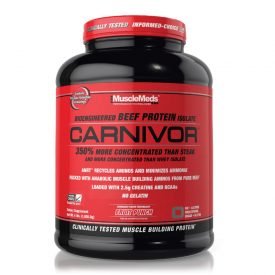
Carnivor is a 100% beef protein isolate that is fast digesting and great tasting for an effective non-dairy protein supplement.
5. Prioritize Recovery
Muscle is built outside of the gym. Make sure to sleep 7–9 hours per night, stretch, stay hydrated, and avoid overtraining.
Final Thoughts: Does Boxing Build Muscle?
Boxing is a powerful training tool that builds lean, defined, and functional muscle while dramatically improving your cardiovascular fitness, speed, and coordination. While it won’t give you the same mass-building effects as traditional bodybuilding, it can absolutely reshape your body, increase your strength, and improve muscular endurance.
For those seeking a shredded, athletic physique, boxing is an excellent choice. If your goal includes muscle size, consider pairing your boxing routine with strength training and a muscle-focused diet plan.
Let us know what you think in the comments below. Also, be sure to follow Generation Iron on Facebook, Twitter, and Instagram.