Jeff Cavaliere Names 7 Exercises That Could Be Making Your Shoulder Pain Worse And How To Fix Them
ATHLEAN-X founder and physical therapist Jeff Cavaliere breaks down seven popular exercises that can aggravate the shoulders, while offering simple fixes to keep them in your routine.
Jeff Cavaliere has built his reputation around finding ways to train hard without sacrificing longevity, and his latest breakdown tackles one of the most common problems lifters face: shoulder pain.
The ATHLEAN-X founder and physical therapist recently revealed that his own shoulder MRI isn’t exactly pretty. Cavaliere says he has dealt with a completely torn labrum, significant rotator cuff damage, degeneration, a subacromial spur, and AC joint issues.

Despite that history, Cavaliere continues to train intensely. His approach isn’t necessarily to eliminate every exercise that bothers the shoulder. Instead, he believes many movements can be modified to reduce unnecessary stress while still providing their muscle-building benefits.
There is one notable exception.
Here are the seven exercises Cavaliere identified and the changes he recommends making.
1. Pull-Ups
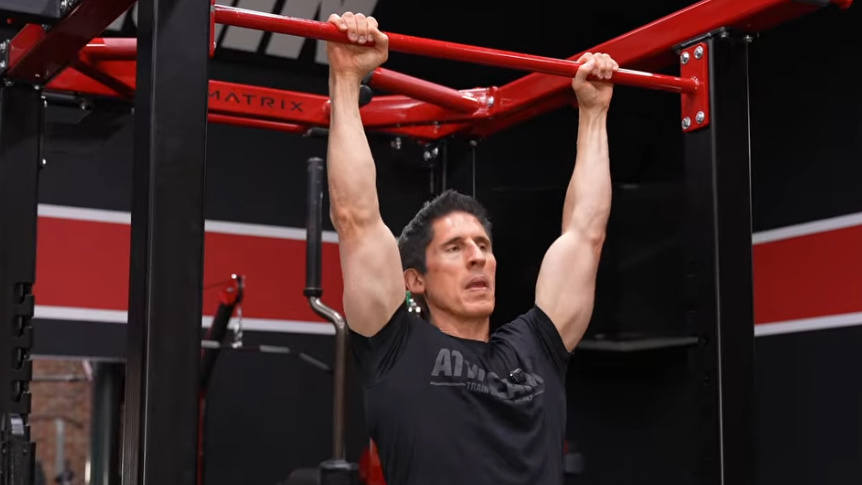
Cavaliere’s first selection might be surprising because pull-ups aren’t usually thought of as a shoulder-damaging exercise.
The potential problem comes at the bottom of the movement. Dropping into a completely relaxed dead hang creates traction through the shoulder joint, something Cavaliere says can be particularly uncomfortable for someone dealing with instability or a labrum injury.
Rather than eliminating pull-ups, he recommends maintaining active tension through the shoulder girdle.
Cavaliere’s fix:
- Pull the shoulders down and away from the ears before beginning each rep.
- Maintain that shoulder and scapular tension at the bottom.
- Lower yourself slowly instead of dropping into the stretched position.
- Still reach full elbow extension without completely relaxing the shoulders.
This allows lifters to maintain a large range of motion without repeatedly dumping their bodyweight into a passive dead hang.
2. Bench Press
The bench press is a much more obvious culprit for irritated shoulders, particularly when technique starts to break down.
Cavaliere points toward excessive elbow flare and a very wide grip as two potential problems. Flaring the elbows increases internal rotation while the shoulder is extended at the bottom of the press, potentially increasing stress on structures at the front of the shoulder.
Cavaliere’s fix:
- Keep the elbows closer to roughly a 45-degree angle from the torso.
- Avoid an unnecessarily wide grip.
- Retract and stabilize the shoulder blades against the bench.
- Don’t allow the shoulders to roll forward as you press.
If those changes aren’t enough, Cavaliere recommends moving from a barbell to dumbbells. Dumbbells allow each arm to move independently and make it easier to align the wrists over the elbows.
He also stresses controlling the eccentric portion rather than quickly dropping the weights toward the chest.
3. Upright Rows
This is the one exercise on Cavaliere’s list that he doesn’t believe is worth saving.
“I cannot stand the upright row,” Cavaliere said.
His concern comes from combining elevation of the arm with internal rotation, particularly when the elbows travel above the wrists. Adding significant resistance can make that position even less shoulder-friendly.
Instead, Cavaliere recommends replacing upright rows with dumbbell high pulls.
The high pull still trains the delts through arm abduction, but Cavaliere has lifters keep the wrists higher than the elbows. This shifts the shoulder toward external rather than internal rotation.
For Cavaliere, there simply isn’t enough benefit to justify keeping upright rows when an alternative can accomplish a similar goal.
4. Low-Bar Squats
The squat might seem like an odd addition to a list about shoulder pain, but the issue isn’t actually the squatting motion.
It’s where you put the bar.
A low-bar back squat requires significant shoulder mobility to hold the bar across the rear delts. For someone with limited external rotation or existing rotator cuff problems, simply getting into position can become uncomfortable.
Cavaliere suggests first experimenting with a slightly wider hand position. If that doesn’t help, there are easier solutions.
Better alternatives include:
Both allow lifters to continue training the squat pattern without forcing the shoulders into the same demanding position.
5. Dips
Cavaliere doesn’t want lifters abandoning dips, especially as they get older. He views the exercise as valuable not only for building the lower chest and triceps but also for developing control and stability while moving your body through space.
The problem occurs when the shoulders roll forward as the lifter descends, particularly when going excessively deep.
Cavaliere’s fix:
- Keep the chest up and forward.
- Pull the shoulders down and away from the ears.
- Maintain control throughout the descent.
- Stop around 90 degrees of elbow flexion rather than chasing maximum depth.
- At the top, actively push through the shoulders instead of simply locking out the elbows.
The goal is to get the desired chest stretch without allowing the shoulder to drift forward into a vulnerable position.
6. Bench Dips
Bench dips present a similar problem, with the added issue of hand positioning.
When the fingers point directly forward, the shoulder can be forced into an uncomfortable position as the body descends and the shoulders begin rolling forward.
Cavaliere’s modification is surprisingly simple: turn the hands outward.
Externally rotating the hands and opening the chest can create a more comfortable shoulder position while still allowing the triceps to reach a strong contraction at the top.
As with regular dips, the priority is keeping the shoulders from collapsing forward at the bottom.
7. Overhead Press
Finally, Cavaliere doesn’t want lifters to abandon overhead pressing simply because their shoulders aren’t perfect.
Beyond building the delts, he argues that reaching and pressing overhead is an important movement pattern involving proper scapular rotation and thoracic extension.
A very wide barbell grip, however, can push the elbows too far out to the sides.
Cavaliere’s fix:
- Narrow the grip on barbell presses.
- Allow the elbows to travel slightly in front of the body.
- With dumbbells, keep the elbows approximately 45 degrees forward instead of directly out to the sides.
- Consider pressing one arm at a time for additional stability.
- Keep the wrist, elbow, and shoulder stacked under the load.
- Use a controlled tempo.
For lifters who lack shoulder stability rather than dealing with a structural injury, Cavaliere believes unilateral pressing can be particularly useful because it makes it easier to create a stable, stacked position.
Cavaliere’s Bigger Message: Train For Longevity
Cavaliere’s overall point isn’t that everyone should stop benching, dipping, squatting, pressing overhead, or doing pull-ups the moment their shoulder feels uncomfortable.
Instead, technique, exercise selection, grip width, range of motion, tempo, and joint positioning can make a significant difference.
There is also an important distinction between modifying training around occasional discomfort and attempting to self-treat an actual shoulder injury. Persistent pain, weakness, instability, or loss of range of motion should be evaluated by an appropriate medical professional.
For Cavaliere, the ultimate goal is finding ways to continue progressing without beating up your joints in the process:
“Aesthetics without durability, that’s just influencer fitness, and that’s not what I do here,”
Image embed via YouTube @athleanx