Build core strength and stability
When people imagine the exercises responsible for a defined, strong core, they usually think of movements that involve crunching or holding still — sit-ups, leg raises, planks, and endless variations of both. One exercise almost never makes that list: the Pallof press. Its name doesn’t exactly advertise that it is an “ab workout,” but don’t let that fool you. The Pallof press is one of the most effective core stability exercises you can perform.
Unlike traditional ab movements that rely on spinal flexion, the Pallof press challenges your body to resist rotation. Using a resistance band or cable machine, you press the handle straight out from your chest while the load tries to twist your torso toward the anchor point. To prevent that rotation, your core has to brace hard — engaging the abs, obliques, and deep stabilizing muscles all at once.
This anti-rotation strength is essential for real-world movement and athletic performance. Whether you’re squatting heavy, pulling from the floor, carrying awkward loads, or simply trying to stay balanced under stress, a stable core keeps everything aligned and powerful. That’s what makes the Pallof press a genuinely functional exercise rather than just another ab finisher.
In this post we here at Generation Iron break down the Pallof press.
How to Do the Pallof Press Properly
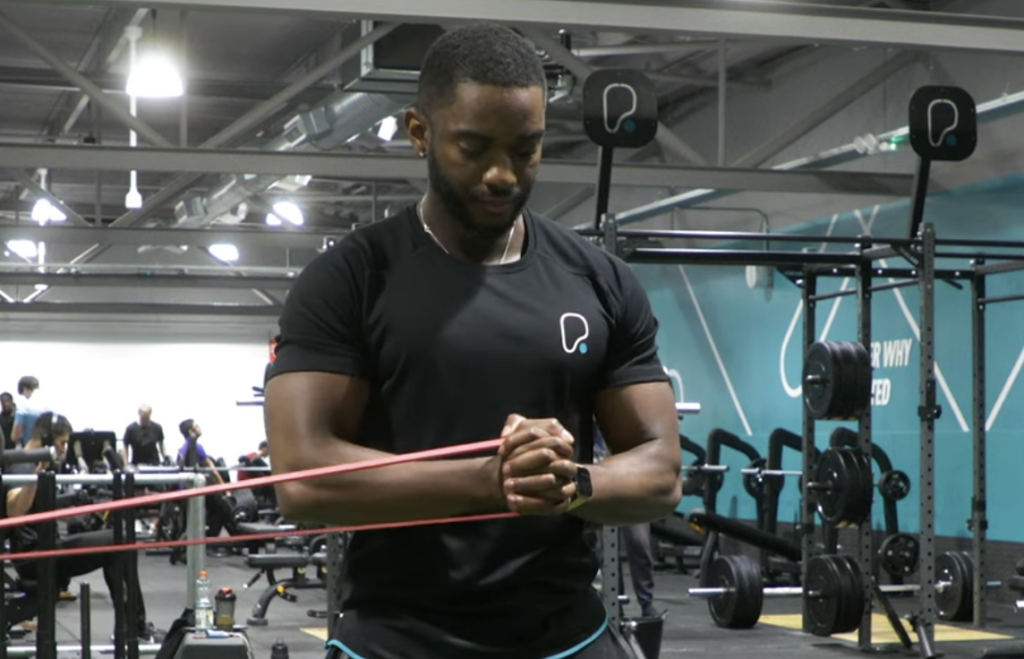
Use the steps below to set up and perform the Pallof press with proper technique.
Step 1 — Set Your Base and Brace
Secure a resistance band to a fixed anchor point at chest height, such as a squat rack or cable column. Stand sideways to the anchor so the band pulls across your body. Hold the band with both hands at your sternum, elbows tucked in. Step away from the anchor until the band is already under tension.
Adopt an athletic stance with soft knees, feet planted, and your torso upright. Brace your core as if preparing to be pushed.
Coaching Tip: Think “tall posture” — ribs down, chest up, and hips stacked under your shoulders.
Step 2 — Press Without Rotating
With your core fully engaged, extend your arms straight out in front of your chest. Squeeze your hands together and keep your shoulders packed down and back. As your arms move away from your body, the band will try to twist you toward the anchor — do not allow it.
Your hips and shoulders should remain square the entire time. The movement is slow, controlled, and deliberate.
Coaching Tip: If your torso rotates or your hips shift, the resistance is too heavy.
Step 3 — Return With Control
Maintain tension through your midsection as you slowly bring your hands back to your chest. Avoid letting your shoulders round forward or your spine collapse. Each rep should look identical from start to finish.
To increase difficulty, either step farther from the anchor point, use a thicker band, or slightly increase the cable weight. The Pallof press isn’t meant for maximal loading — progression should come from better control, longer pauses, or higher rep quality.
Coaching Tip: Exhale slightly as you press to reinforce abdominal bracing.
Pallof Press Sets and Reps
The Pallof press isn’t designed for building massive muscle or chasing heavy numbers. Instead, it shines as a precision tool for improving core control, posture, and stability.
- For Warm-Ups and Injury Prevention:
2–3 sets of 12–15 reps per side with light to moderate resistance. - For Core Strength and Stability:
3–4 sets of 6–10 controlled reps per side using higher tension. - For Skill and Bracing Practice:
4–5 sets of 5 slow reps with a pause at full extension.
Common Pallof Press Mistakes
Even though the movement appears simple, small breakdowns can dramatically reduce its effectiveness. Rotating through the torso, flaring the ribs, locking out the elbows aggressively, or rushing the reps are all common issues. Keeping the movement slow and controlled ensures the core — not momentum — does the work.
Final Thoughts on the Pallof Press
The Pallof press may not look flashy, but its impact on core strength and stability is hard to beat. By training your body to resist rotation, it builds the kind of deep, functional core strength that carries over to nearly every lift and athletic movement. Instead of simply working your abs through motion, the Pallof press teaches you how to stay braced, balanced, and controlled under load.
Whether you’re a beginner learning proper core engagement or an experienced lifter looking to improve performance and reduce injury risk, this exercise fits seamlessly into almost any training program. Keep the resistance manageable, focus on clean technique, and prioritize control over speed. When performed consistently, the Pallof press becomes one of the most effective tools for developing a strong, resilient core that supports everything else you do in the gym.
Let us know what you think in the comments below. Also, be sure to follow Generation Iron on Facebook, Twitter, and Instagram.