The dumbbell single-leg hip thrust improves glute strength and imbalances.
Your hip joints play a crucial role in supporting essential everyday movements such as climbing stairs, walking, bending, and sprinting. Maintaining their strength and functionality is vital for overall mobility and performance.
In this article, we dive into the dumbbell single-leg hip thrust — a powerful exercise designed to target and strengthen your hip muscles. You’ll learn how this variation can boost your functional movement and enhance overall performance. The guide also provides detailed, step-by-step instructions to ensure proper form, along with alternative exercises to help you build a stronger, more resilient hip region.
Overview — What Is the Dumbbell Single Leg Hip Thrust?
The dumbbell single-leg hip thrust is an isolation and unilateral movement that takes your training to intense levels with exceptional muscle and strength benefits. It is a hip thrust variation, and the dumbbell serves as resistance during the exercise.
The major highlight of this routine compared to other hip thrust variations is its unilateral approach. This helps strengthen each side of your target muscles and addresses muscle and strength imbalances. The dumbbell single-leg hip thrust enables you to establish a stronger mind-muscle connection with your target muscles, a key factor in muscle hypertrophy (1).
Dumbbell Single Leg Hip Thrust — Muscles Worked
The dumbbell single-leg hip thrust primarily focuses on strengthening your posterior chain, midsection, and lower body muscles. Working these muscles helps improve your mobility, stability, balance, and reduces the risk of injuries. It targets:
- Glutes: These are the primary movers when thrusting those hips (2).
- Erector Spinae: It runs along the spine and helps maintain your back’s straightness (3).
- Hamstrings: This muscle, located at the back of the thigh, helps support the working leg when thrusting it up. It also assists in bending the non-working leg.
- Quads: You can find these muscles in the front of your thigh, and they help control the movement of your body in the lowering phase.
- Adductors: They are located on the inner parts of your thighs and help keep your legs straight.
How to Do The Dumbbell Single-Leg Hip Thrust
Setting up the dumbbell single leg hip thrust involves using a flat bench and a dumbbell heavy enough for your hips to thrust. Before adding dumbbells to this workout, start with bodyweight movements to get the routine right. This is also a good way to warm up for the major movement. Studies show that doing specific warm-ups can help improve your movements for your major exercises (4).
Here is how you can perform the dumbbell single-leg hip thrust:
- Set up a flat bench and place your upper back across it using a supine position.
- Place the dumbbell weight carefully on your midsection and engage your core muscles.
- Keep one knee bent at 90 degrees with the foot flat on the floor while the other foot is driven to the floor to bridge your hips. It is at the point where you squeeze your glutes.
- Hold this pause for about two to three seconds and slowly lower your hips back to the starting position.
Benefits
Here are some benefits of performing the dumbbell single-leg hip thrust.
Great for Working the Glutes
If you’re looking for well-rounded, strong, defined glutes, the dumbbell single-leg hip thrust is one exercise to have in your arsenal. The glutes add to an aesthetically pleasing physique. It also keeps your trunk erect and gives you better mobility and flexibility.
Improves Your Hip Extension
Doing this routine strengthens the muscles around your hips and improves your mobility. This helps keep the extra load off your lower back because stronger glutes help distribute the weights more evenly and reduce your chances of injury.
Helps Improve the Core
Your core muscles are crucial for better exercise form, stability, and preventing injuries, especially during exercises. Doing this exercise strengthens your core muscles and promotes proper posture, making your routines more effective while reducing the risk of injuries.
Better Mind-Muscle Connection/Addresses Imbalances
The single-leg hip thrust is a unilateral exercise that works each side of your body. This allows you to focus on target muscles better and address specific muscle and strength imbalances for a more effective workout. It also builds a stronger mind-muscle connection, which is a good factor for muscle growth.
Alternative Exercises You Can Try
The single-leg hip thrust isn’t the only exercise you can use to build a stronger body. This isn’t taking away anything from this routine, but adding other alternatives keeps your training interesting and works your muscles differently. Additionally, experts advise mixing up your routines for better muscle and strength gains. Here are some beneficial alternative workouts to try.
Glutes Bridges
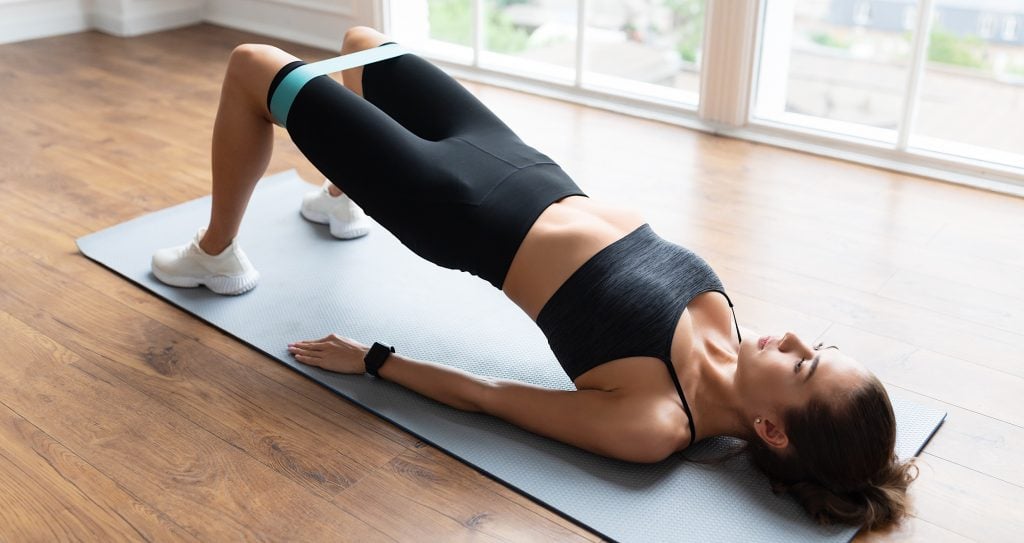
Glute bridges primarily work the glutes, as their name suggests. They are effective bodyweight exercises that are easy and convenient. However, if you’re looking for more resistance, you can use resistance bands, kettlebells, barbells, dumbbells, or even a Smith machine for this routine.
Deadlifts
Deadlifts are the ultimate back exercise. However, they’re not just limited to back building; they work your posterior chain, which includes your glutes, hamstrings, quads, and calves.
Barbell Split Squats
Barbell split squats are a squat variation that works each side of your body unilaterally, just like the dumbbell single-leg hip thrust, to improve your performance. It works similar muscles too, making it an effective alternative to add to your arsenal.
FAQs
Are single-leg hip thrusts effective?
Yes, single-leg thrusts are effective. Adding resistance, like dumbbells, improves your muscle and strength gains. You can use a dumbbell single-leg hip thrust to work your lower body and midsection.
Does the single-leg hip thrust target the glutes?
The single-leg hip thrust primarily targets the gluteal muscles. The glutes are very important for keeping your trunk erect, and they also help with your mobility and stability, improving your overall quality of life.
Does hip thrust reduce the hip size?
Technically, the hip thrust doesn’t reduce hip size. Hip size is largely dependent on genetics. However, performing hip thrusts works your glutes, increasing their muscle mass. This gives the illusion of a smaller hip size because of extra mass added to the glutes.
Follow Generation Iron on Instagram, Facebook, and Twitter for more exercise guides!
References
- Calatayud, J., Vinstrup, J., Jakobsen, M. D., Sundstrup, E., Brandt, M., Jay, K., Colado, J. C., & Andersen, L. L. (2016). Importance of mind-muscle connection during progressive resistance training. European journal of applied physiology, 116(3), 527–533. https://doi.org/10.1007/s00421-015-3305-7
- Neto, W. K., Vieira, T. L., & Gama, E. F. (2019). Barbell Hip Thrust, Muscular Activation and Performance: A Systematic Review. Journal of sports science & medicine, 18(2), 198–206.
- Henson B, Kadiyala B, Edens MA. Anatomy, Back, Muscles. [Updated 2023 Aug 14]. In: StatPearls [Internet]. Treasure Island (FL): StatPearls Publishing; 2025 Jan-. Available from: https://www.ncbi.nlm.nih.gov/books/NBK537074/
- Abad, C. C., Prado, M. L., Ugrinowitsch, C., Tricoli, V., & Barroso, R. (2011). Combination of general and specific warm-ups improves leg-press one repetition maximum compared with specific warm-up in trained individuals. Journal of strength and conditioning research, 25(8), 2242–2245. https://doi.org/10.1519/JSC.0b013e3181e8611b