How the Golden Era Legend Built His Physique
When it comes to legendary bodybuilders, Frank Zane is widely regarded as one of the greatest physiques in bodybuilding history. A three-time Mr. Olympia (1977–1979), Zane was known not for overwhelming mass but for symmetry, proportion, conditioning, and aesthetics. His physique helped define the “Golden Era” of bodybuilding and continues to influence modern competitors and fitness enthusiasts.
If you’re searching for Frank Zane’s workout routine and diet, in this post, we here at Generation Iron break down how Zane trained, how he ate, and how you can apply his principles today.
Who Is Frank Zane?
| Full Name: Frank Zane (Golden Era Bodybuilder) | ||
| Weight | Height | Date Of Birth |
| 185-200 lbs | 5’9″ | 6/28/1942 |
| Division | Era | Nationality |
| Men’s Bodybuilding | 1970s | American |
Frank Zane competed during bodybuilding’s Golden Era alongside legends like Arnold Schwarzenegger and Franco Columbu. Unlike many of his peers, Zane relied on meticulous programming, precision nutrition, and intelligent recovery rather than brute strength alone.
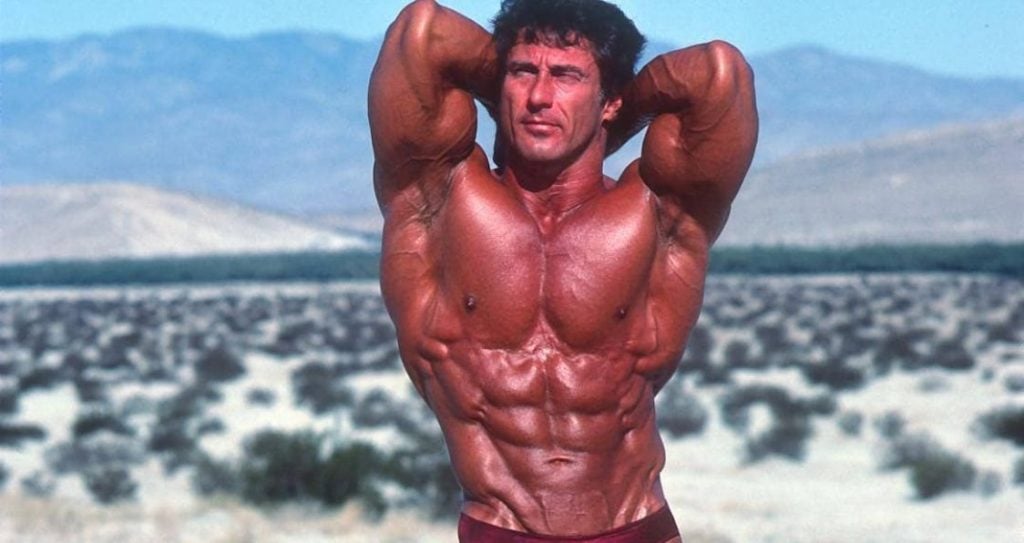
Standing around 5’9” and competing at roughly 185–195 pounds on stage, Zane proved that aesthetics, conditioning, and muscle separation could defeat larger competitors. His approach was methodical, science-based, and years ahead of its time.
Frank Zane’s Training Philosophy

Before diving into his exact split, it’s important to understand the philosophy behind Frank Zane’s workout routine:
- Focus on symmetry and proportion over size
- Moderate weights with strict form
- Higher volume and mind-muscle connection
- Strategic use of supersets and isolation work
- Detailed tracking of workouts
- Regular posing practice
Zane believed bodybuilding was an art form. Every rep had a purpose. Every workout was structured around improving weak points and refining overall balance.
Frank Zane’s Workout Routine
Zane trained 4–6 days per week depending on the phase of his career. He often used a 3-day split performed twice weekly.
Example 3-Day Split
Day 1: Chest, Shoulders, Triceps
Day 2: Back, Biceps
Day 3: Legs, Calves, Abs
Repeat, then rest.
Chest Workout
- Incline Barbell Press – 4 sets of 8–12 reps
- Flat Dumbbell Press – 3–4 sets of 8–12 reps
- Dumbbell Flyes – 3–4 sets of 10–15 reps
- Cable Crossovers – 3 sets of 12–15 reps
Zane emphasized upper chest development to maintain balance and proportion.
Shoulders Workout
- Seated Dumbbell Press – 3–4 sets of 8–12 reps
- Lateral Raises – 4 sets of 10–15 reps
- Rear Delt Flyes – 3–4 sets of 12–15 reps
- Upright Rows – 3 sets of 8–12 reps
He focused heavily on lateral and rear delts to enhance shoulder width and create a classic V-taper.
Triceps Workout
- Close-Grip Bench Press – 3–4 sets of 8–10 reps
- Tricep Pushdowns – 3–4 sets of 10–15 reps
- Overhead Extensions – 3 sets of 10–12 reps
Zane often used controlled tempos and peak contractions.
Back Workout
- Wide-Grip Pull-Ups – 4 sets
- Barbell Rows – 4 sets of 8–12 reps
- Lat Pulldowns – 3–4 sets of 10–12 reps
- Seated Cable Rows – 3 sets of 10–12 reps
He trained for width and thickness but avoided ego lifting.
Biceps Workout
- Barbell Curls – 4 sets of 8–12 reps
- Incline Dumbbell Curls – 3–4 sets of 10–12 reps
- Concentration Curls – 3 sets of 12 reps
Zane was known for peak development and used strict form with a strong mind-muscle connection.
Leg Workout
- Squats – 4 sets of 8–12 reps
- Leg Press – 3–4 sets of 10–15 reps
- Leg Extensions – 3 sets of 12–15 reps
- Leg Curls – 3–4 sets of 10–15 reps
- Standing Calf Raises – 5 sets of 12–20 reps
Zane did not rely solely on heavy squats. He believed in controlled reps and constant tension.
Abs and Core
Frank Zane trained abs frequently, sometimes daily:
- Hanging Leg Raises
- Cable Crunches
- Twisting Crunches
- Vacuum Poses
He practiced vacuum exercises to maintain a tight waist — a signature feature of his physique.
Training Volume and Intensity
Zane typically performed 3–4 sets per exercise with moderate rep ranges (8–15 reps). He preferred volume over maximum weight.
Key elements included:
- Supersets for increased intensity
- Short rest periods
- Precise execution
- Progressive overload tracked in training journals
He believed that stimulation, not annihilation, was the key to muscle growth.
Frank Zane’s Diet Plan
Frank Zane’s diet was structured, clean, and calculated. He was one of the early bodybuilders to emphasize macronutrient tracking and strategic carb manipulation.
Macronutrient Approach
- Moderate protein
- Moderate carbs (adjusted based on season)
- Lower to moderate fats
- Controlled calories
Zane often consumed around 200–250 grams of protein daily depending on body weight and contest prep phase.
Typical Off-Season Diet
Meal 1:
- Eggs or egg whites
- Oatmeal
- Fruit
Meal 2:
- Lean protein (chicken, turkey, tuna)
- Brown rice or potatoes
- Vegetables
Meal 3:
- Protein shake
- Nuts or yogurt
Meal 4:
- Fish or lean beef
- Vegetables
- Sweet potatoes
Meal 5:
- Cottage cheese or casein protein
He ate smaller, balanced meals spaced throughout the day to maintain stable energy and muscle recovery.
Contest Prep Diet
During contest preparation, Zane reduced carbohydrates gradually while keeping protein high. He incorporated:
- Carb cycling
- Sodium manipulation near shows
- Water adjustments before competition
- Increased cardio
He preferred steady-state cardio such as walking or cycling rather than excessive high-intensity training.
Supplements Frank Zane Used
Zane was known for incorporating supplements early in bodybuilding history. His stack often included:
- Whey protein
- Amino acids
- Multivitamins
- Minerals
- Vitamin C
- B-complex
- Fat burners (during contest prep)
He believed supplements should support, not replace, a disciplined diet.
Cardio and Conditioning

Unlike many mass-focused bodybuilders, Zane prioritized conditioning year-round. He incorporated:
- Light to moderate cardio
- Posing practice as calorie-burning work
- Stretching and flexibility training
His goal was to stay relatively lean even in the off-season.
The Mind-Muscle Connection
One of the most important aspects of Frank Zane’s workout routine was mental focus. He visualized muscle contraction during every repetition. He believed concentration enhanced muscle fiber recruitment and improved symmetry.
Zane also practiced meditation and visualization — uncommon at the time — to improve stage presence and performance.
What Made Frank Zane Different?
- He trained for aesthetics, not just size.
- He tracked workouts meticulously.
- He prioritized recovery and longevity.
- He emphasized core control and vacuum training.
- He balanced science with intuition.
His physique proved that bodybuilding is not just about lifting heavy but about sculpting the body deliberately.
Can You Follow Frank Zane’s Workout Today?
Yes, but with adjustments for your experience level.
If you’re a beginner:
- Reduce volume
- Focus on mastering form
- Train 3–4 days per week
If you’re intermediate or advanced:
- Use his 3-day split
- Incorporate supersets
- Track progress
- Practice vacuum exercises
Zane’s principles remain relevant today, especially for those pursuing classic physique or aesthetic bodybuilding.
Final Thoughts on Frank Zane’s Workout and Diet

Frank Zane’s workout routine and diet remain some of the most studied programs in bodybuilding history. His focus on symmetry, precision, conditioning, and intelligent nutrition helped him defeat larger competitors and redefine the sport.
Rather than chasing maximum weight, Zane chased perfection in form and proportion. His legacy continues to inspire modern bodybuilders who value aesthetics over sheer mass.
If your goal is to build a balanced, lean, classic physique, studying Frank Zane’s training and diet principles may be one of the smartest moves you can make.
Generation Iron may receive commissions on purchases made through our links. See our disclosure page for more information.
Let us know what you think in the comments below. Also, be sure to follow Generation Iron on Facebook, Twitter, and Instagram.